


1. Overview
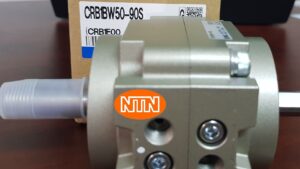
The SMC MSQB200R belongs to the MSQ series rotary table actuators, a pneumatic rack-and-pinion type that integrates a rotary actuator with a precision bearing table.
It allows direct mounting of the workpiece or tooling on the table face, providing compact and rigid rotary motion.
The model is suitable for applications requiring precise, limited-angle rotation with high load support and smooth operation.
Main features:
Integrated bearing-supported rotary table for high rigidity.
Compact and lightweight design compared with separate actuator + bearing setups.
Adjustable rotation angle (up to about 190°).
Available with auto switches for end-position sensing.
Options for shock absorbers to reduce impact at end of rotation.
Maintenance-free operation using clean, non-lubricated air.
2. Key Specifications (MSQB200R – Size 200)
| Parameter | Typical Value / Description |
|---|---|
| Actuation type | Pneumatic, rack & pinion mechanism |
| Working medium | Compressed air (non-lubricated) |
| Operating pressure range | 0.2 to 1.0 MPa |
| Ambient / fluid temperature | 0 – 60 °C (no freezing) |
| Rotation range | Up to 190° (adjustable with stopper bolts) |
| Rotation adjustment | Fine angle adjustment via end bolts |
| Repeatability | High (improved in precision version) |
| Cushioning | Optional shock absorbers or rubber bumpers |
| Bearing structure | Large-diameter, integrated cross-roller bearing for high moment load |
| Load capability | Can support both axial and radial loads directly on the table |
| Mounting orientation | Any direction (horizontal, vertical, inverted) |
| Auto switch compatibility | Yes (reed or solid-state type) |
| Typical radial play | ≤ 0.01 mm |
| Operating life | Long life with minimal maintenance when used under proper air conditions |
3. Industrial Applications
The MSQB200R is widely used in factory automation, assembly, and material-handling systems, especially where compact, precise, and repeatable rotation is required.
Typical uses include:
Indexing tables – For rotating parts to different positions in assembly or inspection processes.
Workpiece orientation – Adjusting component position during assembly or packaging.
Transfer mechanisms – Rotating carriers between processing stations in production lines.
Fixture or jig rotation – For machining, gluing, or inspection where limited angular rotation is needed.
Pick-and-place systems – As a rotation axis on end-effectors or tooling heads.
Testing or measuring setups – To rotate products for scanning or camera inspection.
Packaging and labeling equipment – For aligning or rotating bottles, containers, or labels.